
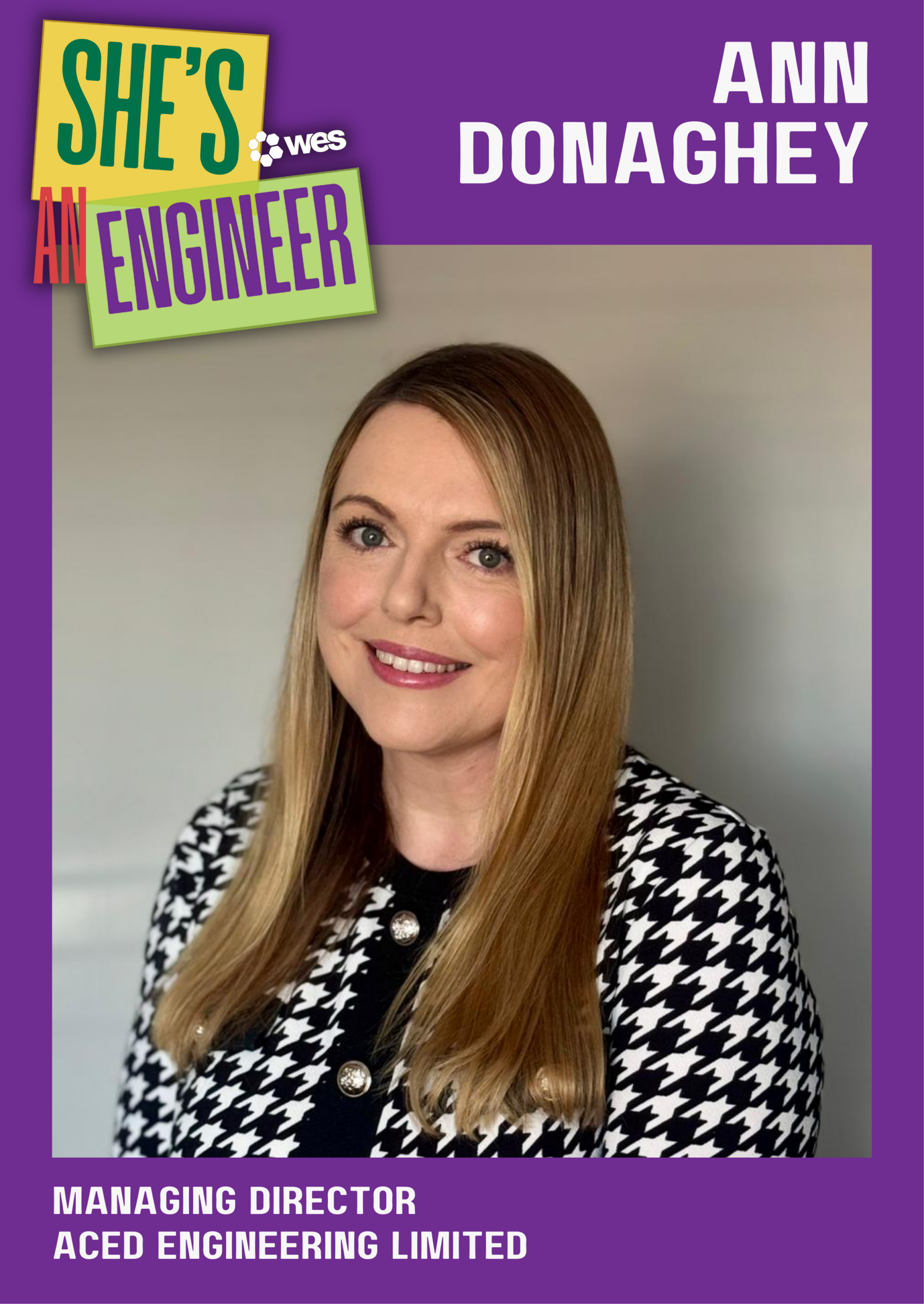
She’s a Manufacturing Engineer – Ann Donaghey
She’s an Engineer features the lives and stories of our inspiring women engineers who are members of WES
Shaping the Future: My Journey as a Woman in Manufacturing
I make complex factories run safely every day while cutting energy use and improving the products.
I run factory change projects so everyday manufacturing is safer, faster and more sustainable. In simple terms I make sure heat, cooling, water and power systems, people and data work together so products like food is made Right First Time. I plan improvements, choose equipment, lead teams and work around production to install equipment with minimal stoppages. When something goes wrong, I use evidence to find the root cause of the problem, fix it and stop it coming back again. I track safety, quality, cost, delivery and environmental factors and help the team improve a little bit more each week. I also cut energy and waste by reusing heat, using cleaner power and smarter controls. My job blends people leadership with practical science and technology so that factories runs well today and even better tomorrow.
What does a typical day at work look like for you?
A typical day combines science, teamwork, and leadership. I start by reviewing how the factory ran overnight: checking safety, quality and energy data; then meeting the team on the production floor to discuss what went well and what needs improving.
Much of my day is spent planning or leading change projects. That might mean reviewing designs for new equipment, solving technical problems or coordinating with contractors to install systems safely while production continues. I help people understand the “why” behind improvements to motivate everyone to help design better systems that make their jobs easier.
No two days are the same: One day I might be in a hard hat solving a chilled-water issue; the next, presenting a carbon-reduction plan or mentoring a young engineer. What stays constant is the goal: to make manufacturing safer, smarter and more sustainable: turning science and teamwork into real-world impact working towards achieving the Sustainable Development Goals.
What advice would you give to your 15 year old self
I would tell my 15-year-old self to be curious about how things work and not to worry about having all the answers. Every skill builds on another, even when it does not seem important at the time. Learn from people who do very different jobs: you will be surprised how often their ideas help you solve problems later!
Do not be afraid to stand out or take the harder path if it feels right. Confidence grows from trying, not from knowing. Remember that kindness and teamwork are as powerful as technical skill, and that real success is about improving things for others as well as yourself.
….And finally, believe that you can shape your own path — whether that is fixing machines, leading teams or tackling climate change. Every decision is a small step towards the person you are meant to become.
Who or what inspired you to get into engineering?
Leonardo da Vinci inspired me because he showed that art and science are two sides of the same curiosity: both about understanding how the world works and how to make it better. I loved the beauty in both: the creativity of design and the logic of engineering.
At first, I thought I wanted to be a pharmacist, so I started working in a pharmacy at 14 to see what it was really like. Around that time, a natural disaster struck Brazil and I remember watching bulk medicines being flown in by helicopter to save lives. It was the first time I understood the power of manufacturing at scale: how chemistry, engineering and systems could come together to improve quality of life and outcomes for people. That moment changed everything and set me on the path to become a chemical engineer and I’ve never looked back.
What are the best and worst things about the job?
“The best thing about my job is seeing ideas turn into reality: watching a system I helped design come to life, making production safer, cleaner and more efficient. I love working with people from different backgrounds and seeing how science, teamwork and creativity combine to solve complex problems. Every project is a chance to learn something new, to make an impact that lasts and to prove that sustainable manufacturing is not just possible but powerful.
The hardest part of my job is that change takes time. Large factories are like living ecosystems: you have to balance technology, culture and cost all at once. Sometimes progress feels slow, but it teaches patience, persistence and the value of bringing people with you. Even on the tough days, I know the work matters, because every improvement, however small, moves us closer to a safer, smarter and more sustainable future.”
What was your route into Engineering?
Full-time university degree
Where do you see your industry in 25-50 years’ time?
“In 25 to 50 years, I believe manufacturing will look very different from today, but its purpose will stay the same: to meet human needs safely, efficiently and responsibly. Factories will be cleaner, smaller and more connected to their local communities and customers. They will be powered mainly by renewable energy, with minimal Scope 3 transport logistics and circular systems where waste becomes raw material.
Digital tools and artificial intelligence will manage much of the routine work, turning data into instant decisions and freeing people to focus on creativity, innovation and problem solving. Automation will not replace people but will work alongside them, improving safety and unlocking new skills.
Materials will be bio-based and fully traceable, supply chains will be transparent from soil to shelf, and every product will carry an environmental footprint as familiar as a nutrition label is today. Engineering will be a truly global, inclusive and regenerative discipline: one that designs not just for profit but, for the wellbeing of people and our planet.”
How does your work relate to the sustainable development goals?
“My work directly supports several of the UN Sustainable Development Goals, particularly SDG 9 (Industry, Innovation and Infrastructure), SDG 12 (Responsible Consumption and Production) and SDG 13 (Climate Action). I lead manufacturing transformation projects that make factories safer, smarter and more sustainable: designing systems that reduce energy, water and waste while improving efficiency and product quality.
By embedding circular design, renewable energy and digital tools, I help shift operations from linear “take-make-waste” models towards regenerative, closed-loop systems. This includes recovering heat, reusing materials and integrating cleaner utilities into large-scale food production.
Equally important, I focus on the people side of sustainability. Through inclusive leadership and capability building, I contribute to SDG 5 (Gender Equality) and SDG 8 (Decent Work and Economic Growth), helping teams build skills for a more sustainable and equitable industrial future. In short, my role turns sustainability goals into day-to-day engineering practice.”
Have you had any career setbacks or challenges, and how did you overcome them?
Yes. I experienced redundancy earlier in my career, and at the time it felt like a major setback. I had poured my energy into a project that ended when the company restructured, and it was difficult to separate my sense of purpose from the role itself.
Looking back, it became one of the most valuable turning points of my career. It gave me the space to pause, reflect and rediscover what truly motivated me: using engineering to make a positive impact. I invested time in new learning, built new networks and said yes to opportunities that stretched me. That period ultimately led to international roles, greater confidence and a clearer sense of direction.
I even used my redundancy money to move with my husband to New Zealand — turning uncertainty into an adventure. It taught me that resilience is not just about bouncing back, but about bouncing forward: using change as a catalyst for growth.