
Climate Emergency Group – News
CEG News– January 2026
Reflecting on the power of the Climate Emergency Group
Paula McMahon
After almost three years at the helm as Chair of WES’s Climate Emergency Group (#WESCEG) I am handing over the WES ‘green baton’ to the capable hands of Ann Donaghey.
Transitions offer us an opportunity to reflect. So here are my top three reflections:
- My first observation is how quickly time flies! They say this happens when you are having fun and I have to say I have. I am proud of the sterling work the group have done we have certainly had fun along the way.
- Looking back through the 31 (!) sets of minutes really brings home that good stuff does not happen by magic or in isolation. To create visible success there is a lot of collective effort behind the scenes.
- Sometimes we all need help. We have been blessed with having experts within our group and networks which have allowed us to have external speakers to enthuse and inform.
So what am I most proud of?
It has been a great honour to see everyone live and breathe my ‘Together We Can’ mantra. Our wonderful CEG team have supported each other through disappointments and celebrations directly related to CEG work and beyond it.
What was my biggest learning moment?
Our Open Letter. This was a great example of collaboration and had an impressive list of signatures supporting it plus we even got MPs responding to us. However, the public uptake was disappointing. But we did not dismay and used this learning as part of the book chapter we wrote collectively to help ourselves and others enhance their campaigns in the future.
What was the most impactful initiative?
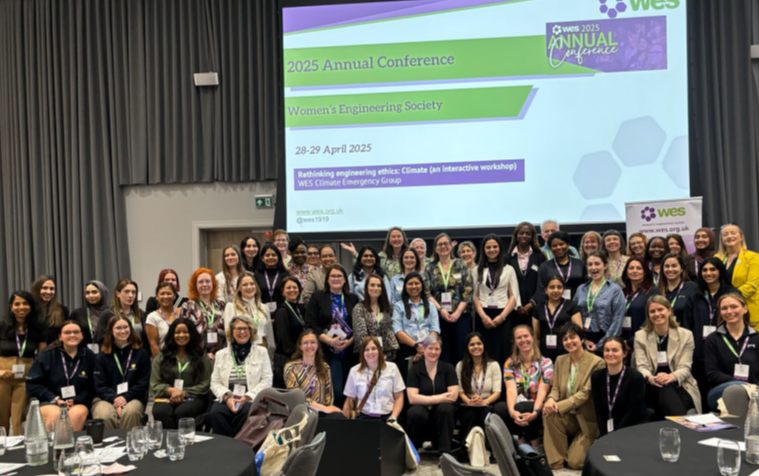
The CEG workshops on ethical dilemmas at the 2025 WES Annual Conference was very special. Immediate feedback from the 121 inter discipline participants included being ‘dynamic and full of energy‘ the ‘outstanding session’. 99% of respondents reported ‘taking something away’ and that it was ‘thought provoking’ which would feed into their daily work. And for CEG there was lots of added value as a direct result new CEG members, linked up researchers, provided climate education at 2 colleges, resulted in follow on help to entrepreneurs. This work has and shall continue to feed into wider industry work as it acted as a pilot of what became a deliver your own Rethinking engineering ethics: Climate Roundtable for the ICE.
My advice to the CEG Members?
Stop being so shy about raising your profile and that of the CEG work – shout up and shout loud!
Au Revour not Goodbye
I leave the group with a happy heart and an Action Plan, so keep watching out for #WESCEG. The large active members are in great hands with Ann as Chair and Siân as Secretary. And I am not going too far! Never forget that Together We Can.
Paula McMahon WES CEG Chair 2023-2026
CEG News – December 2023
COP28 and Women in Engineering
So the sand has settled and COP28UAE is over but was it a “Good COP” or “Bad COP”?
Following our last meeting we decided in our WES Climate Emergency Group (CEG) to write a blog so here goes!
Promising progress was made on climate justice, energy transition, agricultural resilience, food security, and a wide range of other sectors closely associated with the 1.5°C target set in the Paris Agreement.
One of my industry contacts, Giulia Chierchia, EVP Strategy, Sustainability and Ventures BP posted these major achievements on LinkedIn which I would draw out as positives from the event:
– The Global Decarbonization Accelerator: a package of measures to speed up the energy transition and reduce global emissions. More than 115 countries will work together to triple renewables energy capacity by 2030.
– The Oil and Gas Decarbonization Charter: bringing together more than 50 National Oil Companies (NOCs) and international energy producers to aim to reduce operational emissions and get to near zero methane emissions by 2030. As the signatories represent more than 40% of global oil and gas production, this could be significant and a strong foundation to build on.
– Global Flaring and Methane Reduction (GFMR) Partnership: a new multi-donor trust fund launched by the World Bank focused on helping developing countries cut carbon dioxide and methane emissions generated by the oil and gas industry. Also worth noting that ca $800m was pledged by countries to the “Loss and Damage Fund” launched at COP27.
I believe having such an influential figure as Dr Sultan Al Jaber, Head of ADNOC and Emirati politician, as Chair was important despite the misgivings of many. The fact is that NOCs make up around 60% of global oil and gas production and hold 90% of reserves. If you don’t get them onboard together with the major global energy companies then 1.5degC is a pipedream.
There was considerable discussion around the “phase out” or “phase down” of oil, gas, and coal with significant and strong views from all sides. In the end a compromise was achieved but this area will remain contentious as many countries are/were relying on these commodities for current and future economic growth and societal improvements. I think the loss and damage funds and other monies will need to be significantly increased to fully compensate them.
Diversity and Inclusion was also important at COP28. The panels and discussions brought together diverse groups from governments, NGOs, indigenous communities, youth representation, business, and industry. While some may have felt that their voices were not
heard as much as others, I think the fact that they were all at the table was significant. We won’t achieve our net zero goals without everyone from all sectors and organisations contributing and working together for the common good of humanity.
It’s been highlighted regularly that women are impacted disproportionately by the effects of climate change because of their roles in many societies. Published data by UN Women has shown that by 2050, climate change may push up to 158 million more women and girls into poverty and see 236 million more face food insecurity. However, women also play an important role in climate solutions, as was highlighted on ‘Gender Equality Day’ at COP28 where women showcased how they are driving change. A number of influential women commented (COP28: Women and climate advocates driving forward change together | UN News):
“Women stand at the forefront of the climate battle. Whether as the scientists, legislators, indigenous leaders, youth activists, they are fighting to keep the 1.5 degrees Celsius target alive,” UN Deputy Secretary-General Amina Mohammed said in her video remarks.
Echoing that sentiment, Jemimah Njuki, Chief, Economic Empowerment at UN Women said: “In spite of them not having the resources, we are also seeing a lot of actions led by women and girls and if we can give them the resources – including the financial resources – to do more, I think our world is going to be better for it.”
What about the role of Women in Engineering and particularly those in the energy sector? Well at least based on my experience coaching several thousand at school, university, in early careers and in more senior roles I can vouch for the fact that the energy transition is bringing greater equity, diversity and inclusion into the industry. I would estimate that around 50% of those I see are women and many from engineering backgrounds. I’m convinced that this trend will continue and that the numbers we see today of women in engineering (16.5%) and women in energy (22%) will grow. I think that is inextricably linked to the importance of the energy transition and achieving our net zero and sustainability goals in the global community.
In closing I think COP28 made some real progress and was overall a “good COP”, however I don’t think an annual health check is sufficient to gauge where we are and very much like the value of an annual appraisal, we need to be monitoring outcomes and progress much more regularly. While we move to COP29 in Baku let’s remember that the impacts of climate change don’t wait a year for more discussion and updates, and let’s keep the feet firmly on the solutions accelerator!
In that respect we in the WES CEG need to firmly continue highlighting the impact of climate change on women in engineering and the wider, global community, and promoting solutions to the issues we face.
Vince Pizzoni 22/12/23